Tuesday, April 28, 2015

Hindus and Sikhs- Oneness and infighting

This is one of the most crucial and controversial topics of Indian politics. Though writing down about it on a blog may not get it the kind of attention that it deserves and may not be read with the seriousness  that it should be, but that won't stop me from verbalizing it for the greater good of the country and the humanity. It's a common century old phenomenon that Hindu radicals keeps on claiming the Hindutva of the sikh gurus on various grounds and sikh radicals keep on rubbishing their claims with their counter-arguments and we, the normal and the neutral Indians follow them blindly out of our faiths and get slaughtered for them like scapegoats, serving to the best of their vested interests.

I firmly believe that the normal citizens of the country shouldn't fight in the name of religion especially Hindus and Sikhs because there are dedicated militant organizations in both the communities who are solely prepared for this purpose. Hindus have their RSS, VHP, Bajrang Dal etc. etc. and sikhs have their Nihangs, Dal Khalsa, Taksalis and even SGPC task force can do the job of paid goons very well. So if there are such organizations present around you, who serve the purpose of conditioning tender minds to fight and die for religion till the last breath, then there's no point for a common man to pick up sword to protect his religion.

Even there are fanatic preachers in both the communities who make hollow predictions as "There won't be any sikh left one day and all the sikhs will come back to the hindu fold" or "One day the hindus will realize their mistakes and fall in guru's feet for repentance and convert to sikhsim".... Rubbish and Hilarious.... Isn't it ?? Though many of the radical Hindus try their level best to project Sikhism as the offshoot of Hinduism, there are Sikh radicals who try their level best to project Sikhism as a refined and a superior form of  Hinduism. If we just rubbish all these statements and try to be rational in addressing the issue, we can address it better if we try and figure it out from a socio-political perspective rather than a religious perspective.

Though I do not want to use that old reference of the word "Hindu" being a geographical term rather than a religious one, I just want to point out that fact that both the religions have emerged on their own and can take care of themselves, we just need to look after ourselves not our religions for that matter. I believe that the ultimate solution for Hindu and Sikh masses is peaceful coexistence. Because both these communities have diverted from their basic tenants if they introspect.


Where sikhs assume that hindus have snubbed them being a majority community in India and tried their level best to curb their separate and original identity, their real individuality, Hindus especially in Punjab accuse sikhs for alienation. Though, it may be in the best interest of the masses that the Article 25 of the constitution (which recoganizes sikhs as hindus) gets cancelled or repealed, but I feel that it may be in the best interest of the ruling class to keep the dilemma going in order to use the insecurity of "identity crisis" to bank on the sikh dominated vote bank in Punjab.

I have touched the issue of separate sikh identity in my article "Sehajdhari rights and sikh quota" but if such a law is passed it will have some ripple effects in the centuries old cohesive existence of the two communities. Honestly, being a liberal sikh, not associated with any radical or a separatist outfit, a law should be passed to establish the separate identity of sikhs, purely on humanitarian grounds. One has the right to be oneself and no one can take away his/ her individuality and religious identity is a vital part of a person's individuality and making it subservient to some other religious identity directly effects that person' zeal for life.

Though I have not mentioned about the work of a famous sikh encyclopedist Kahn Singh Nabha called "Hum Hindu Nahin" (Sikhs are not Hindus) written in 1898 whereby he technically proved by using references from both sikh and hindu scriptures that these are two different communities. But one thing is clear that this book is 117 years old and hasn't been able to achieve its objective yet in the Indian polity, then we can definitely say that either something is wrong with the book or something is wrong with the Indian polity ;-)

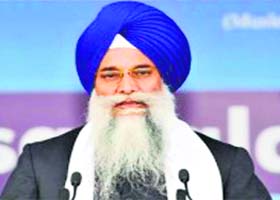
Jathedar- The CEO of Akal Takhat

That's not an odd comparison if you just make an effort to compare the Jathedar of a Takhat and the CEO (Chief Executive Officer) of an MNC (Multi-National Company). I'm doing it completely in the positive light as in my article "Cult leaders: The economic elites of Punjab", I proved that religion is also an industry like the other industries and people who have acquired offices in religious institutions ought to play a key role and discharge the duties attached to that office. CEO is one of top notch positions in an MNC just like the "Jathedar" in a religious institution called "Takhat" which is a temporal seat for co-ordination between religious and political affairs.

Just like the saying goes that,"With great power comes great responsibility", we can easily figure out that the job of a "Jathedar" isn't easy like that of a CEO. Though primarily associated with the policy-making, the nature of policies made by "Jathedars"(usually called "Singh Sahibaan" out of reverence by the sikhs) has to keep some very critical facts and conditions in mind before making a policy and issuing an edict or a diktat for the community across the globe to follow. These factors are:

1) Political pressure: "Jathedars" have to work in harmony with the govt. Majority of the Jathedars of the modern era succumb to the political pressure but there are examples of Jathedars like "Akali Phoola Singh" who dared to issue a diktat against Maharaja Ranjit Singh out of his multiple marriage alliances as this was against sikh tenants and the "tankha" (religious punishment) announced for Ranjit Singh was 20 slashes of hunter on his back and the Maharaja literally took it. Nowadays, the CEO's are also under immense political and market pressure to keep the organization going.

2) Dress Code: Just like a CEO adheres to a dress code like formals or semi-formals, Jathedars too have a dress code to adhere to. Though next generation CEO's like Mark Zuckerberg defies such protocols, the Jathedars too have somehow brought relevant changes in their dress-code to suit contemporary requirement. It's simple "kurta" & "chooridaar payjama" with a pointed turban nowadays unlike a "chola" and a "Dumala-dastaar" in the olden days.

3) Appeasement of radicals: Well, the CEO may not have to face any radicals or fanatics but he definitely has to figure out the institutional loyalty of his employees and act accordingly, similarly, for the "Jathedar" the fanatics and the radicals are the most loyal of the people associated with the institution and he cannot afford to make them angry as they have the militant like tendencies to rebel and the CEO has to make sure about the retention of institutionally loyal employees.

4) Projection of a universal image: Just like a CEO makes sure that the society in general, and not just employees, get benefited from his corporate house and launches various schemes in the name of "Corporate Social Responsibility", Jathedar also has to make sure that the projection of sikhism remains tolerant and universal and gives a nod to various philanthropic activities.

5) Carry forward the glorious legacy: Both the Jathedar and the CEO very well know that they are the temporary incumbents of their posts and the institution is above them, they have to make sure that the sanctity of the institution stays in tact. Both the seats are subject to corporate or a perpetual succession.


Though both these positions i.e. a CEO and a Jathedar are highly empowered and fetch immense social status and power, there is another aspect to it. Focusing wholly-solely on religious institution now, the Jathedar is also an ex-officio member of SGPC which is otherwise, a house of 180 members (now reduced due to the formation of separate SGPC by Haryana) democratically elected through adult franchise.

Now this is where the powers of a Jathedar take a jolt, when the decision on most of the financial matters are taken by the President of SGPC who is more like the MD (Managing Director) of all the gurdwaras falling under his jurisdiction. Actually, the SGPC President decides how much money should be spent on which project. Hence, the principle of "Unity of command" gets violated leaving a scope for the diversion and embezzlement of funds. Some intellectuals claim that the funds are used lesser for panthic or religious interests and more for the purpose of political party funding, hence going directly in the pockets of the ruling family of the state. And this is exactly what weakens the institution of "Akal Takhat".


This is the major grudge of the contemporary sikhs that "Akal Takhat" was above politics at the time of its establishment by the sixth guru, Sri Guru Hargobind Sahib ji. Acquisition of the post of Jathedar by religious leaders subservient to the politicians has immensely reduced the sanctity and the powers of "Akal Takaht" and has made it an institution inferior to even the ministerial positions of the state govt. Though I have used the picture of the incumbent Jathedar of Akal Takhat in my article but this is purely for reference purpose and not a personal attack.

As Punjabis or Indians, we are very well aware of the fact that extra-constitutional authorities operate in the Indian polity. I have already referred to such authorities in my other articles and if as sikhs we have failed to make "Akal Takhat" an authority of that stature then we need to introspect. What is holding us back ?? Have we failed to bring forward a 20th century leader and a strong individual like Giani Gurmukh Singh Musafir, who held various top positions i.e. of a Jathedar Akal Takhat, 3 time MP, CM of Punjab and Rajya sabha member in his lifetime. We need somebody who is religiously and constitutionally right to acquire this position and take the sikh community to the acme of glory.


Monday, April 27, 2015

Farmer Suicide menace in Punjab


Its always a matter of pride to associate yourself with a land that symbolizes divinity, culture, valour and abundance. This is exactly the same feeling that over-whelms us when we say that we belong to Punjab, the state known as bread-basket of India. The north Indian states of Punjab, Haryana and UP feed over 1.2 billion Indians. But now things are different as it is really hurtful to know the ground realities that have made Punjab a mere graveyard of the meek and helpless feeders of society. The issue that needs to be addressed immediately is unbelievably dreadful for the presenters in a way
that every single aspect verbalized on it resonates through the ears of the dead farmers and instead of acting as a sigh of relief for their dependents, it acts like salt over their wounds.

The Punjab that we all know, is no more the same place to live for those who're aware of the bitter truths of the faulty governance and inefficient administration. Rising above this blame game, it's a matter of those thousands of dead who've been victimized by either poverty or ignorance. Their plight never seems to be self-induced but exemplify the tyranny of suppressed class that has been the outcome of social evils like poverty, unemployment, illetracy, ignorance and social-stratification propagating through the ages.

Whether the Ministers in central govt. or state govt., Whether MP's or MLA's, Whether IAS or PCS officers. They all must realize that every moment wasted in exaggerating the issue about the causes, consequences and statitics is adding to the plight of the "have-nots"who've surrendered in front of the system which has taken away the lives of the bread-winners in their families. The lavish offices of beaureucrats and ministers, the legislative assembly of the state and the Parliament of India seems too far away for the poor farmers who've shed every drop of their sweat and blood to feed them.

There is an utmost need to awaken the entire nation about the fact that how can the starved bellies perform their jobs in the IT hubs, silicon vallies, Corporate offices, Flamboyant shopping malls, multiplexes or Special Economic Zones (SEZ's). Everyone needs food to live whether rich or poor, educated or illetrate. How can the nation flourish if it is running after embellishing itself with infrastructural landmarks at the cost of an emptied bread basket ??

Now the question arises whether Punjab needs a boost in the primary sector i.e. agriculture & allied activities, that has brought laurels to it in the past or does it need to grow in the more employment and revenue-generating sector i.e.industry and the service sector. Though several media outlets
in the country still claims that agriculture accounts for 70% employment and just over 20% revenue generation. Apart from this poor input-output ratio, agriculture is worst hit by poor storage and distribution of food grains and hundreds of millions of tonnes of food grains rot due to poor administration.

Now! Apart from the role of govt. officials/ agencies and the NGO's working on this menace. The key lies in the hands of the nextgen youth of Punjab. Does the nextgen youth obsessed with urban lifestyle, spiky hair cuts, fashion, accessories, music & dancing and SUV's will be able to come up with a solution or even care about understanding the horrible things happening (in the name of agriculture) over their ancestral land or will they prefer to rationalize on the issue and prefer to live in denial in the name of urbanization or modernization.

Will we ever see the Punjab that once we were proud of ?? or, Are we going through a crisis situation, that we never expected, to see a whole new Punjab ?? Let's pray to the almighty to give us strength to save its honor in the uncertain and enigmatic future.

Friday, April 24, 2015

Marriage and sexual conduct in Sikhism

I decided to touch this topic because, we Indians have actually forgotten our glorious heritage and have become too much regressive. Sexual conduct not only is a critical topic to discuss in order to make a better atmosphere within the county but also to educate youngsters about the rising cases of rapes and sexual violence. Unless, the future generations are not thoroughly educated about this issue, there is a minimal chance to check crime against women, children and and helpless people.

Sexual energy of the young generation definitely needs to be regulated but in a country where live-in relationships have been legalized, there should not be any sexual violence, but this has not happened even after legalization of live-in relationships. Sometimes, we Indians are so much consumed with the belief of the superiority of the western culture that we assume that there's no sexual frustration in the west or there's no violence against women and children in the west, but that is not true. Though statistics have shown that the sale of porn video DVD's and photos is maximum in the conservative middle eastern countries but their draconian laws that even go to the extent of crippling the offender from his private part induces a very high degree of fear in the minds of the criminals. We cannot afford to have such laws in India which I believe is also a conservative nation.

First we need to have a clarity on the fact that it's not just the unstable teenagers who commit this crime, it could be anyone, it could be a mentally disturbed adult committing it out of a broken marriage or separation. We also need to reinvent our roots where talking about "sex" was never a taboo and I've already mentioned about the presence of Ajanta & Ellora caves and Maharishi Vatsyayana's work. Though I want to highlight a fact here that there are some full-time brothels working in major cities of India and prostitution is an absolutely legal business in the cities of- Allahabad, Jaipur, Mumbai, Muzaffarpur, Nagpur, New Delhi and Pune. But these red-light areas have a limited outreach confined to their surrounding urban and rural areas only. But the presence of these brothels do not ensure a complete absence of sexual violence in these areas. Neither it is possible to have govt. approved brothels in the conservative places of India having a religious heritage like Varanasi, Haridwaar, Amritsar etc. Hence, I would rather take a neutral but a conservative stand on checking the sexual violence in the country by just saying that the legal punishment of a sexual offender should be increased and adequate measures should be taken to rehabilitate the victim with full dignity.

Now talking about the sikh rehat-maryada, it has been clearly defined in the rehatnama that a sikh should limit himself/ herself to only his/her spouse and pre-marital or extra-marital sex accounts to a major "kurehat".  The unmarried are advised to practice celibacy and marriage is solemnized in the presence of the holy Sri Guru Granth Sahib and sikhs strictly practice monogamy.


No forceful seduction into marriage is allowed, neither bride capturing or stealing is allowed neither a custom of paying a bride price persists. This tradition was present in the tribal parts of India and is still practiced in some areas. Though, Guru Nanak always advocated that householder's life is the best form of worship and encouraged his sikhs to have a "grihasthi" because only in such a condition i.e. "grihasthi", the person can know the true meaning of selfless service. Though some radical sikh preachers say that sikh couples should have sex only for procreation (i.e. only to have kids) but their logic seems redundant in front of the fact that "sex" is not just a physical phenomenon happening due to the secretion of hormones. It's a psycho-somatic phenomenon strengthening an emotional bond between the couple.

Unlike Islam, which allows its followers to have multiple wives at one instance of time, sikhism allows subsequent marriage only in case of death of a previous spouse. Though there are some intellectuals who claim that polygamy was practiced by the tenth guru but there are some accounts to prove that guru sahib solemnized second marriage after losing the first wife and the third wife was symbolically named as the mother of Khalsa and wasn't the biological mother of any of the sahibzadas. Though both Lord Ram and Guru Nanak taught us the same thing i.e. to be loyal to our spouses and the practice of monogamy becoming a standard tradition followed by hindus and sikhs across India based on their teachings but Guru Nanak didn't ever subject his better half to "Agni pareeksha".


Weaponization and civility


Sikhs are considered as one of the greatest martial races ever in the history of the world. Though the nature of religion and purity of its culture has been diluted over the years but one thing is for sure that there people who are trying to keep this glorious tradition alive. Undoubtedly, Guru Nanak Dev ji started a new philosophy of oneness of the creator and the creation and equality of all the humanity, never posed a threat of ceasing the political power to his contemporary ruling class. As, Sikhism was in the nascent stage it never got violent repression. Most of the time, Guru Nanak only has to rely on logic and common sense to prove the practicality of his philosophy. but as the time passed and sikhism started to gain ground, its repression too was started openly and the fifth guru, Guru Arjan Dev ji had to sacrifice his life to defend the faith. The era of making sikhs a martial community started with the sixth guru who encouraged his followers to hold wrestling bouts and get trained with the sharp edged-weapons.


But the martial character became utmost important by the time the tenth sikh guru assumed guruship and hence he had to formally institutionalize the martial character of sikhism by creating the "Khalsa". Though, he transferred guruship to Guru Granth sahib but there was another important religious text contained the actual heritage of the martial sikh history. "Dasam granth" or "Bachittar Natak" is the granth solely written by Sri Guru Gobind Singh ji unlike Sri Guru Granth Sahib which contains the verses of various sikh gurus and other non-sikh sages or seers.There are clear cut "banis" in "dasam granth" which prove that Guru Gobind Singh ji considered weapons or "shartra" to be the ultimate source of empowerment of his followers and some hymns are dedicated solely for the worship of weapons. Hymns like "Chandi di Vaar" and "Shastra Naam Mala" were written for purpose of weapon-worship as weapons were considered to be the ultimate protectors of the life and honor of the community. The nature of these hymns isn't at all aggressive but very moving and inspirational. The spirit behind these hymns clearly show that Guru sahib never advocated bloodshed but always inspired his sikhs to be ready to make war to restore peace. Even the olden days sikh warriors used to recite these hymns before going to the battlefield in-order to have that "Bir Rass" (also known as adrenaline rush in scientific terminology) to fearlessly

Now that the nature of society has changed so has nature of weapons. Some people even question the validity and existence of religion and consider it irrelevant and out-dated. Now the modern day weapons are far more destructive and hence there needs to be a mechanism to keep a check on its usage by the govt. In India, the civilians are only allowed to carry licensed NPB (Non-Prohibited Bore) weapons for self-defense. These weapons are much lesser in potency as compared to the PB (Prohibited Bore) weapons which are specifically meant for the armed forces.


Now, if we take the current scenario into account and realize the insecurities that a common man has to go through in day to day life, it is justified for him to carry a weapon for self-defense. Weapon doesn't only makes the person feel more secured physically but the weapon-holder also feels emboldened to express himself freely. The freedom of expression is definitely curbed many
 a times by either the religious fundamentalists or authoritarian govt. regimes. But, weaponization of civil society would ensure the empowerment of the common citizen provided there is some sort of moral guidelines attached with its usage. Those guidelines may not only be the provisions given in the Arms Act of 1959 or the Arms act of 1962, they could somehow be clubbed with the traditional religious values.

Now, militarization has been an Indian tradition much before the birth of Khalsa. The last names of "Singh" and "Kaur" derived from "Kuwar" were used primarily by the "Kshatriyas" of north India. Hence, there is sizable Indian population including both sikhs and non-sikhs that has weapons as a part of their heritage and they should be allowed to carry them out of their sentiments to carry forward their legacy.

Guru Gobind Singh ji has clearly said that "Shastran ke adheen hai Raj." which clearly shows that the political power of a country is directly dependent on its arms. We can clearly see the validity of his words if we consider the case of hegemonic domination of USA over the rest of the world. It is ruling the world because of its biggest artillery, maximum number of nuclear weapons and WMD's. Even the governments spending higher on their defense budgets are considered to be bolder than those who spend in some other areas. I'm quoting such examples because I can clearly see the validity of Guru Gobind Singh ji's wisdom in it and some other country else than India is taking advantage of that wisdom.

Guru sahib also said in Zafarnama written to Aurangzeb:
"Choo'n kaar az hamah heeltay dar guzasht,
Halaal ast buradan ba shamsheer dast."  which means,
"When all the other means fail, it is righteous to pick up sword (use force)"
but the motive behind the words of the prophet (known as "Sarbans-Daani") who sacrificed everything for the community and the country is based on complete selflessness.


Thursday, April 23, 2015

Turban - A Universal Symbol


It is often difficult to live as someone who cares, nurtures, gives, protects, sacrifices and who fights for a cause. It is though really easy to talk about someone's heroic deeds but actually it's really tough to live as one. Our Guru, Guru Gobind Singh ji made us such heroes and called us his Singh who would care, nurture, give, protect, sacrifice and fight for a cause. Though, it's really easy to find a cause to fight for but it's tough to actually fight for one. I'll just try to ignite some fire in the fellow community-men to fight for the honor of our Turban, many news about whose dishonor we painfully come across every day.


Being grown up as a sikh, I've always considered turban as sacred. I've always worn it gracefully with pride. I'm known for my turban and when I imagine myself at the place of a fellow sikh who just came across turban-frisking, my heart bleeds. There might be many verses in Sri Guru Granth Sahib which refer to turban as an important symbol but being a Punjabi sikh, turban has been very much into my blood and my culture. I feel very hurt when I see people around criticizing and abandoning it in the name of universality and oneness with the whole humanity. Actully, those friends of mine might be forgetting that it is not just the sikh community which is known for its turban but many other communities like Rajputs and Pathans also used it as a vital part of their attire which clearly shows a wide acceptability of turban making it a universal symbol representing pride, honor, integrity, self-esteem, patience, audacity and royalty.

Though it's really strange to see that Turban is rarely visible only in Hindu weddings and has almost vanished from the urban Muslim culture but it also gives me a sense of pride and I feel the triumph of being a sikh when I realize that it is only and only my community which has URBANISED it and is fighting for its integrity in the present time.

Though, it is not just the Global Terrorism (or the phenomenon of so called Islamic fundamentalism) which forces our youth to abandon and indirectly disrespect it but in many parts of India, especially Punjab which is undergoing a phenomenon called modernization which gives our youths a delusion that abandoning their turbans will make them modern and actually bring them on a universal platform.

Though, the grief-struck present Punjab, unlike the Punjab of olden days can be easily rated as backward and way behind times where people aren't mush aware of the phenomenon of post-modernism which not only revitalizes the olden traditions but also establishes perfect harmony between the traditional values and modern social norms. The phenomenon of post-modernism needs to gain more strength within our community to make our people realize the glorious heritage that we're blessed with.

We generally love to talk about our real life heroes like - Bhagat Singh, Banda Singh Bahadur, Bhagat Puran Singh ji, Master Tara Singh, Kahn Singh Nabha, Dr. Manmohan Singh etc. Though it's really tough to generalize and find something common between all these great personalities but one thing is for sure that they've all dedicated their lives to their calling, their sacred work, which they've always considered bigger than themselves.

With sikhi being blessed to us, we're all gifted with a purpose to dedicate our lives to and turban is a concrete manifestation of that purpose, that calling. Many other lame excuses are given by our youth to advocate their apostasy and abandonment of turban to catch-up with the latest trends in fashion but such boys of ours don't realize that turban itself defines a perfect style statement. Tying a turban doesn't take more time than meticulously shaving-off your beards and styling your haircut using a hair-gel. Boys putting up in hostels, PG's or shared accommodations can easily make an observation on this.

Now, keeping aside all these real life experiments, one thing is sure that ultimately it all depends upon the choices that individuals make to shape up their destiny and I just want the youth of our community to make choices which not only benefit themselves but also our community and by keeping their Turbans in tact, our youths will not only project themselves as bold individuals(who believe in their individuality) who've dared to give away their heads to their GURU, but they'll also make sure that our community and its glorious heritage will last long and our SARDARI stays intact for ages.


Wednesday, April 22, 2015

Cult Leaders: The economic elites of Punjab


We won't be wrong if we say that majority of the rich , famous and successful people of India live in the metropolitan cities like Delhi and Mumbai. If we are living in such areas we can easily imagine some HNI's (High Net-worth Individuals) having a fortune of hundreds or thousands or even lakhs of crores. Suppose if someone is referring to an HNI having a net-worth of say 500-crores, then we'll most likely assume that the point of reference must be a  cricketer or some successful local businessman (where 1 million US$ = 6.5 crore INR approx.). If we hear someone having a net-worth of say 5000-crores, we assume that it must be some celebrity actor or a corporate leader of a higher stature.If we hear about someone having a fortune of over 50000-crores or even 1 lakh crores, we easily figure out that it can't be anyone else than the economic elites of the country like Tatas, Birlas, Ambanis or Adanis. 

It's not a new thing to come across that people living in metropolitan cities condemning life in small towns and being highly critical of the career prospects (be it a job or self-employment) in these areas and out-rightly call them regressive and backward as far as the lifestyle is concerned. I believe that India as a whole is a conservative nation and has some pockets mainly metropolitan cities that have some sort of cosmopolitanism in its culture. Whether it's Punjab, UP, Bihar, Haryana, Maharashtra, Gujrat or any other state, the basic cultural fabric is woven by the conservatives living in that area. Hence, youngsters having a modern outlook towards life always have a tough time adjusting in their hometowns and they feel choked in such an atmosphere and hence aspire to get out of there in pursuit of better life and more freedom to live life on their own terms. Those having more resources prefer to leave the country as such but those who are professionally sound and career-conscious prefer to move to a bigger town for better career prospects. This horizontal mobility of young population is based on the firmly held conviction that if they stay in their home state, there is little chance for career growth.

Now, a thought for all those educated people who either use religion as a stress-buster or just a subject of discussion or consider it an outdated concept for the present civil society. How we define religion ?? It's Hindi translation into the word "Dharma" may get us out of context but sticking to the English term "Religion", we can have its multiple definitions and the most profoundly accepted universal definition is that "Religion is a way of life." Characteristics of religion would be:
1) Belief in the supernatural
2) Voluminous religious text
3) Set of values and beliefs
4) Set of taboos
5) Peculiar insignia
6) Segregation of sacredness and profanity
OK now let's move onto another term "Industry" and study its definition and characteristics. Industry, in Lehman's terms,  could be defined as a set of homogeneous firms (big or small in number) producing a homogeneous product or rendering a particular service. General features of Industry would be:
1) A Market
2) Products/ Services
3) Consumers
4) Service providers
5) Marketing strategies
6) Competition etc. etc.
Now, will it be wrong to say that religion if incorporated and commercialized can very well be called an industry?? Because the industry not only provides employment opportunities to the skilled labor but also opens doors for self-employment for the big fish. And we have ample amount of self employed cult leaders (commonly referred to as "Dere wale Babe") in Punjab who are the BIG fish of the industry called religion.

There are innumerable examples of such cults that have become too powerful to be snubbed by SGPC, hence they indulge in defamation of such cults, the most common example to raise your eyebrows would be "Dera Sacha Sauda" led by Gurmeet Ram Rahim Singh, as using derogatory language for him on religious platforms has become a common trend.


Now we can very well imagine the extent of his power and security cover that, he has survived major attacks on his life by the sikh radicals. Not only this, at least twice a dozen of political leaders as big as MLA's and Ministers from both Punjab and Haryana seek his blessings to empower their vote banks. Once I just came across his photo with the CM of Punjab Mr. PS Badal which I'll share here.


We can clearly see Mr. Badal standing and praying in front of him with folded hands. Now, I don't need to enlighten the readers about the extent of power of Badal family as they are the power elites of Punjab who can very well control the govt. even if they are not a part of it. But Babas like Gurmeet Ram Rahim belong to the category of economic elites who are very well in a position to control the power elites or the people running the govt.

Actually, Dera Sacha sauda isn't the only example of a powerful dera in Punjab. There are other deras which might be even more powerful. Deras like Radhaswami, Nirankaris, Naam-dharis too have immense wealth and power and govt. is in no position to function without their co-operation. Now taking into account all this dera culture of Punjab, can't we compare it with the culture of Europe of late 18th and early 19th century which is usually referred to as "Dark Age of Europe" because there was no scientific temperament, there was rule of ignorance & superstition and religion was the only institution that could lead to the upward mobility of people. Europe was considered liberated from the dark ages after the era of industrialization. Now it would be unfair to say that there is zero industrialization in Punjab or India but industry is definitely in a demented state in Punjab and I'm sure science and modernization must be a nightmare for those babas like Gurmeet Ram Rahim who capitalize on people's fear and entice them with their lavish lifestyles, palatial estates and a fleet of luxury cars and SUV's.

So I think it's either people like these babas who're not letting the common man grow and come out of the dark ages or it's just that there was nothing like dark age in the world and religion continues to enjoy the status of an undisputed money-making business since time-immemorial as it has the ability to capitalize on people's fears. Religion in one form or the other will continue to be a part of people's lives but Karl Marx's theory cannot be overlooked in which he says "Religion is an opium of the masses" but I think his theory can be better complimented by saying that: "If religion is an opium of the masses, it certainly is a luxury of the classes".

But as a Punjabi I would really like to see this Dera culture fading away and the genuine industries, besides religion, help in the transformation of the state from a mere hub of deras and babas to the hub of careers and opportunities.