Showing posts with label sikhism. Show all posts

Sunday, June 7, 2015

Money & Wealth in Sikhism

This is the issue around which the modern day life revolves. How to make money ?? How to accumulate wealth ?? And we're so much dipped in earning our livelihoods and paying our bills that we have no time to sit and think which way our life is going. Though religion has a primary role in giving a purpose and a direction to human life, it certainly has laid down some guidelines for its followers about making money and accumulating wealth. Usually, sikhs in general think of having money as a positive thing and simply call it "Babe di kirpa" as it is generally believed that more the money, more is the "kirpa" but once having understood the technicality of Sikhism, this notion gets mirror opposite. Money or wealth are usually referred to as "Maya" in both Sikhism and Hinduism, though "Maya" is a much wider term and in technical terms means something which creates illusion or an illusion itself. So, can we consider wealth as something which creates an illusion ??


Actually, this topic is very well studied and analysed by eminent sociologists like Karl Marx and Max Weber and there are various sociological facts that can be stated in detail to elaborate on this topic but I would prefer to keep things more generalized in order to make the issue interesting and widely discussed.

Though Guru Nanak did teach us about making a truthful living by saying "kirat karo" or "dasaa'n- nauaa'n di kirat karo" but Sikhism is a religion that believes in the "other-worldly asceticism" just like Hinduism and Islam. Though we can also say that Sikhism teaches one to live a truthful life and the way baptized sikhs live is really austere and constrained as they are taught to live a simple life, away from glamour and extravagance, focusing more on the needs of oneself and the family. Ideally, a sikh should be selfless in spending his money and should give priority to the needs of his family and should also give away one-tenth of his earnings (called "Daswandh") for religious cause. "Daswandh" is similar to the concept of "Tithing" in Christianity where the followers (Catholics or Protestants) are instructed to give one-tenth of their earnings for the Church or the Cathedral. Unlike the Eastern philosophies Protestantism believes in "this-worldly asceticism" where protestants are instructed to consider work as worship and live a life of austerity in order to create and accumulate wealth and create the "Kingdom of GOD" on this world through their righteous earnings.

Though Sikhism has the features of both "this-worldly" as well as the "other-worldly" asceticism, there are verses in Gurbani which consider the accumulation of wealth as a sin. On Page 417 of Sri Guru Granth Sahib, it is stated that:

ਇਸੁ ਜਰ ਕਾਰਣਿ ਘਣੀ ਵਿਗੁਤੀ ਇਨਿ ਜਰ ਘਣੀ ਖੁਆਈ ॥
ਪਾਪਾ ਬਾਝਹੁ ਹੋਵੈ ਨਾਹੀ ਮੁਇਆ ਸਾਥਿ ਨ ਜਾਈ ॥
For the sake of this wealth, so many were ruined; because of this wealth, so many have been disgraced.
It was not gathered without sin, and it does not go along with the dead.

Hence, we can conclude that the accumulation of wealth somehow carries a negative notion as per the religion. Some eminent sociologists like Marx and Weber did conclude that  the religion of the Indian subcontinent i.e. Hinduism primarily is not fit for the framework of Capitalism hence, India needed some exposure to the protestant ethics of Christianity to open doors for Capitalist economy. And in Sikhism, we have also seen the growing tolerance for Capitalism as there are some highly successful capitalists who have huge fortunes amounting to even hundreds or thousands of crores living within and outside India. And surprisingly, these capitalists having huge fortunes have much more say in the working of religious or political institutions. In sikhism, Gurudwaras or the community centers are the places where religion and politics converge. This indicates that Sikhism is somehow losing its democratic or egalitarian spirit where a common sikh, not having huge fortunes is finding it hard to make his/her voice heard even in the day-to-day panthic affairs.

In order to reflect a real life picture, it is worth mentioning here about the sycophancy and favoritism of the managing committees of the religious shrines for the rich and powerful. Actually, they're more concerned with the monetary offerings at the temples or gurdwaras regardless of the religion being critical of wealth as it can cover-up all the worldly-sins committed in order to accumulate it. In the end, I would say that the need of the hour is to strike the right chord and find a balance in the governance of the holy shrines where everyone has the right to contribute and have a say, regardless the size of his/ her fortune.

Tuesday, April 21, 2015

My Thoughts Regarding our Religion


At times, I have preferred to go with the prevailing wind and be critical about my own religion, pointing out common flaws like apostasy, cultism, favoritism, bias, etc. But today I am standing back and looking at the larger picture, the brighter side of things as it were, and I want to put down a few reasons why I feel Sikhism stands out as a unique and powerful path in today's world. 

1) It is not based on mythology but has a recorded history with ample amount of data and reference text in order to authenticate the time and venue of the occurrence of important events and their chronology.


2) The message of its founder was purely universal in nature and is applicable to the entire humanity. It didn't denounce any other existing religion but instead gave birth to a new cosmopolitan ideology.


3) The Siri Guru Granth Sahib stands not simply as a scripture. It is the embodiment of the Shabd Guru. It speaks not to the head but to the soul.


4) It gives full respect to the Doctrine of predestination, but also to one's calling in life, according to which work is considered sacred, but it never equates self-worth with net-worth as it gives emphasis on spiritual sovereignty and not the accumulation of wealth.


5) It provides perfect harmony between work and worship and encourages its followers to live a householder's life with a practical, dynamic balance between these two.


6) It provides seekers with the technology to live spiritually in the world but not of it.


7) It provides guidelines to experience nobility and self-mastery at the same time by the example of its 10th Guru.


8) It never claims to be the result or the source/parent of any other religion. It is clear about its origin and independent identity.


9) It does not, in any way, declare non-Sikhs as infidels.


10) It is not at all proselytizing in nature and opposes forced and politically-motivated conversions.


11) It is absolutely egalitarian in nature as it opposes the caste system that results in discrimination and is one of the reasons behind social stratification.


12) It doesn't encourage nudity or carnality for realization of GOD.


13) No male child or adolescent is compelled to go through the painful process of circumcision.


14) No devotee has to go through the process of cutting, shaving or uprooting their hairs in order to prove renunciation or commitment.


15) It encourages its followers to have a family life and not escape from worldly responsibilities in the name of spirituality.


16) Bride capturing, stealing or forceful seduction into marriage is not permitted. This is commonly known as "Asura", "Rakshasa" and "Paisacha" form of marriage. Neither a bride-price nor a dowry is ever required for marriage.


17) The dead are gracefully cremated and their earthly bodies are not left to rot.


18) No offender of the code of conduct is sent to a place like the "tower of silence" but are allowed to state a reason for the offence and are allowed back by small remuneration and performance of community service.


19) It lays emphasis on forgiveness and embodies the true spirit of non-violence, understanding that it is a position of strength, not weakness and that force may be used only when all other means have failed. Sikhs always stand in defense of other’s rights to live and worship as they please.


20) All its sacred shrines are open to the entire humanity irrespective of caste, creed, color, race, religion, sex or nationality.


Caste System in Sikh community


It would be completely unfair to shy away from the fact the there has been distortion of Sikh tenets and principles of Sikhism as we’ve entered the 547th year of our inception. Bringing this issue in public won’t be a sign of biasness but an endeavor to make the Sikh Diaspora self-aware of the current challenges the community faces in the land of its origin, Punjab.
Though once known as the land of 5 rivers has not only shrunk in size but also lost the grace of its glorious multi-culturalism fabricated with the universality of the teachings of the Sikh gurus. Our bad luck being Indian/ Punjabi Sikhs is the we have to go with the flow of what seems to be a river of poisonous anti-Sikh forces carrying the Sikh masks.
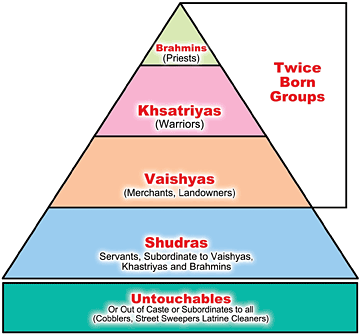
Caste System, an evil that Guru Nanak was strictly against, and dispelled people’s ignorance about it by saying “Manas ki jaat sabh ekay pehchaanbo” seems to have been finding its stronghold in Punjab where the Sikh community is clearly divided into a set of castes which are stratified in a way that taking birth in one case is considered to be a blessing while taking birth in another is considered to be a curse. The caste system operates so strongly in some rural parts of Punjab that people have established caste-specific gurudwaras, cremation grounds, wells, places of congregation.
Just like the profession based caste system that was prevalent in ancient India and is still prevalent today had the following hierarchy.


Moreover the caste status became hereditary and rigid with the passage of time and currently it lays very strong basis for vote-bank politics in India.

Now considering the polity of Punjab, there can be various classifications made on the basis of castes. “Jatts Sikhs” who were actually land-tillers have turned out to be the strongest community by virtue of its resources and its population. Demographically, the community that follows it in political space is that of “B/M (Balmiki/Majhbi) Sikhs”. These are the two major communities having a power struggle as Jatt Sikhs enjoying the monopoly of being on top most of the time as the most prominent leaders in the state belong to this community and the top level state executive positions (ministries) converging towards this community and currently towards a particular family.
Now, my motive isn’t to spread hatred for any particular community or a family but to draw a snapshot of real-time political environment of the state in an objective and an unbiased way. The phenomenon of “Sanskritisation” too is clearly visible in the youth of Punjab whereby the non-jatts try to imitate the Jatts in order to have a delusion of their upward mobility. It doesn’t end there, a low ranking govt. official of this community considers himself emboldened to ignore the orders of a senior official if he/ she doesn’t belong to the same dominant community by virtue of his caste.
This is not the end of castes in the Sikh community. There are other castes like Arora Sikhs, Khatri Sikhs and Kamboj Sikhs that are demographically too far behind to assert themselves politically as they are too small in number. Hence, considered to be below Jatts in the caste hierarchy, out of which Kamboj Sikhs enjoy the OBC (Other Backward Classes) status in the state govt. jobs and B/M Sikhs enjoy SC (Scheduled Caste) status. Hence, Kamboj and B/M Sikhs are protectively discriminated and given some preferences and privileges while recruitment in govt. jobs through reservation but Arora and Khatri Sikhs, who are actually least in number, are kept devoid of it.
This caste set up isn’t just visible in the state assembly or govt. institutions but is also visible in the formation of the SGPC, where the allotment of tickets for contesting the elections is made, off the record, with the motive of garnering the caste-based vote bank.
Now without being much judgmental, I would seek the reaction of Sikhs residing outside Punjab. I just want to make sure the truth about existing and operational caste system doesn’t stay untold or untouched and we don’t live in denial any more about it. The truth had to be told, so I did the same.